Subscribe to our – Get With The Seasons – Newsletter
On the 31st of May, Organiclea hosted their second open day of the year, and 14 of us from Vegbox made the short trip to Walthamstow to an organic food oasis tucked just on the edge of the Big Smoke.
As you wind your way up the road towards Organiclea, the city begins to loosen its grip. If you know what you’re looking for, you can see the Jerusalem artichokes stand tall along the verge on your left, almost like sentries marking the boundary, while on the other side herbs buzz with bees and insects. Then the large glasshouse appears, glinting in the sun, and beside it, a beautifully hand-painted milk float.

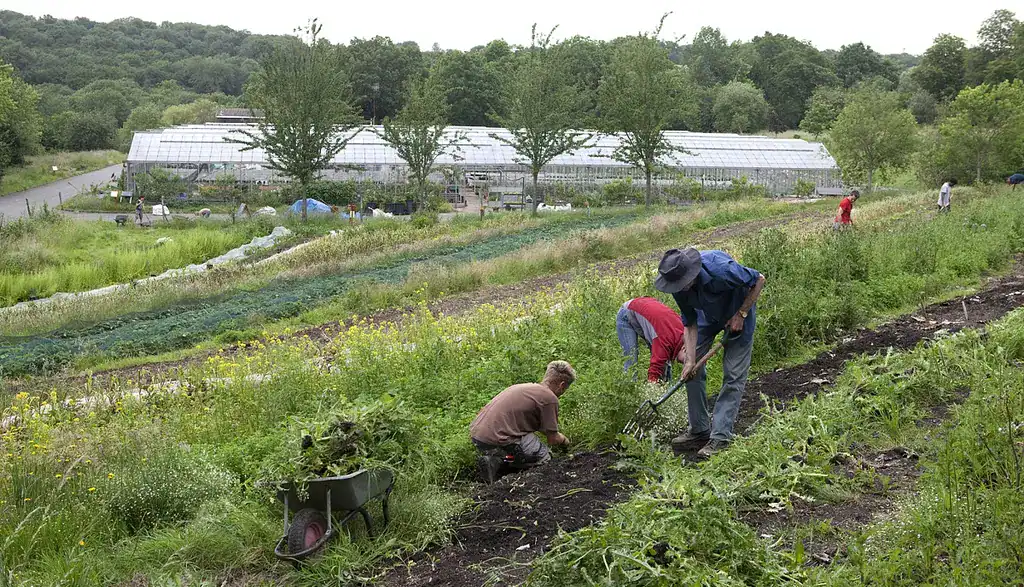
Organiclea sits on a 12-acre site with around 3 acres dedicated to a market garden. It doesn’t look like a typical farm; everything feels more integrated and slightly higgledy-piggledy. Fields are full of a variety of different crops, and fruit trees are interspersed through the woodland.
The open day had a plant sale, Q&As, workshops on sustainability — but the real draw is the tour. It’s the chance to be guided around the site and have all of the little nooks and crannies pointed out to you, and to get a better sense of what it takes to run an organic market garden.
Under Concrete, There is Soil
Organiclea was once a council plant nursery, a very different kind of growing system. Large sections of the site were once sealed under plastic, stone, and concrete — designed for raising rows of potted trees destined for planting across Walthamstow, rather than balancing ecology with food production.
To become a certified organic growing site, the first thing they had to do was strip away that manmade layer and get back to the soil underneath.
Once the soil has been uncovered it reveals a heavy London clay — the kind that can crack into something almost like brick in summer, then turn slippery and slow in winter. It’s not an easy medium to work with. Over 16 years Organiclea has added layers of homegrown compost, slowly building structure and gradually adding softness to what is naturally a very dense soil.
Organic Pest Control
The tour started inside the greenhouse, where the tables were laden with all sorts of seedlings — from corn to onions, aubergine to salads — everything pushing up as summer approaches.

As a certified organic growing site they cannot use chemical pesticides, so Organiclea works with layered biological relationships. They have built habitats for predator insects and sometimes introduce beneficial wasps, but the star of the show is calendula. Its stem is sticky and traps aphids and whiteflies, it releases oils which deter hornworms and nematodes, and the flower attracts predators like ladybirds, lacewings, and hoverflies, which eat pests too. Is there anything it can’t do?

As we step outside we see a row of trees tucked right up against the greenhouse — peaches and nectarines. Not easy to grow in the UK, but able to produce fruit because of the warmth given off by the greenhouse.
Soil R&R
Just outside the greenhouse is Organiclea’s largest field. It’s not especially big — certainly nothing like the vast rolling fields of an industrial farm — but it’s impressive nonetheless. Unlike those farms, where a single crop can stretch to the horizon, this field is a patchwork of different vegetables, each row growing something different.
Here, Organiclea runs a ten-year rotation cycle designed to keep the soil healthy over the long term. Eight different families of vegetables move slowly around the field, with two years at the end of the cycle given over to green manure. Rotations like this help prevent pests and diseases from building up, balance nutrient use, and give the soil time to recover.

At the end of the cycle, sections of the field are covered with black plastic to suppress weeds. Rather than repeatedly digging or rotavating the soil, time and darkness do much of the work, creating a clean slate into which beans — the first crop in the rotation — can be planted.
It’s Getting Hot Out Here
Sunday the 31st was a hot day. Many of the guests at Organiclea were huddled in the shade or frolicking in the woodland, where there is a roundhouse, playground, and many other secrets to discover.
As the planet continues to get warmer year on year, growers are having to put in more and more water infrastructure to keep their land productive. Organiclea is no different and has a deep borehole — around 90 metres down — that provides a reliable supply from underground. Above ground, rainwater is captured and stored in large tanks holding up to 100,000 litres, turning rainfall into a buffered resource rather than a passing event (and they are considering building another storage system soon).
More recently, a large pond-reservoir has been added as an emergency backup. It’s two metres deep at its centre and lined for extra reliability, even though the surrounding clay already holds water reasonably well. It is both practical and ecological: frogs, newts and dragonflies have already made it their home, turning it into a small predator hub for the wider site.

Looking ahead
There is much more to share, but I’ll resist the urge to write any more. What stayed with me most wasn’t any particular crop or growing technique, but the reminder that food production doesn’t have to be industrial, extractive, or hidden away behind fences. Organiclea shows what can happen when people commit to stewarding land over the long term and work with ecological systems rather than against them.
Organiclea will be opening its doors again in September for their apple tasting open day — a chance to see the site in a different season, when the summer’s work turns into autumn’s harvest.
This newsletter grew out of our work running Kentish Town Vegbox, a community-owned, not-for-profit veg scheme connecting North Londoners with small UK farms since 2012. Every week we see the beauty and the challenges of seasonal farming up close, and we wanted to create a space to share those stories with you.
We hope this newsletter helps you feel more grounded in the seasons, more connected to the farmers who grow your food, and more inspired by the incredible work happening on UK farms.
See you in your inbox soon,
Caleb & The Vegbox Team